
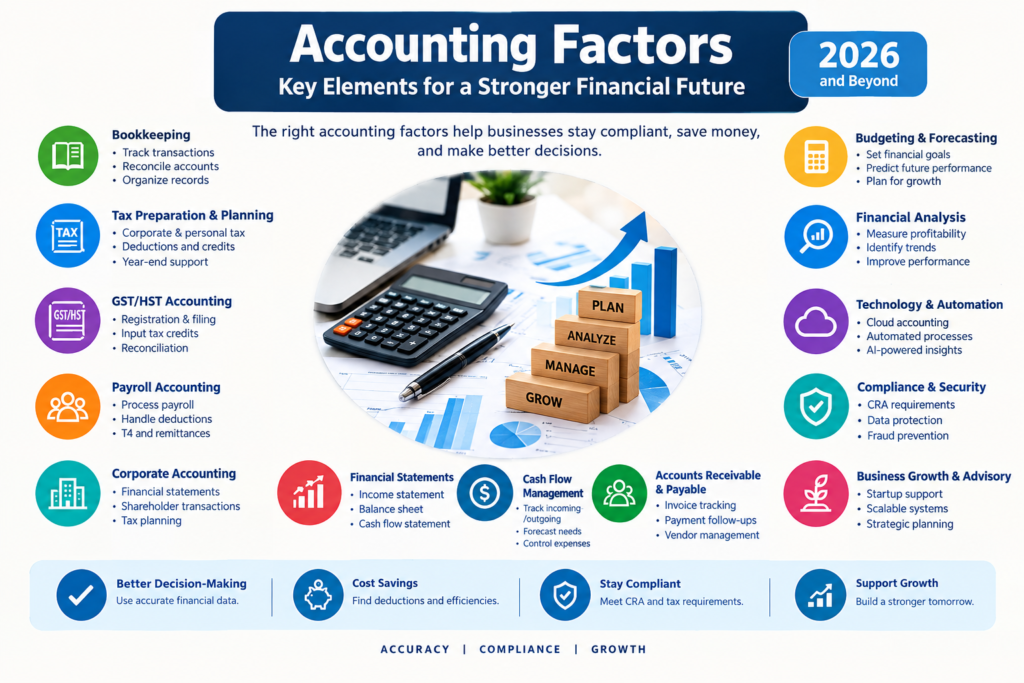
Accounting is an important part of running a successful business in Canada. In 2026, businesses need more than basic bookkeeping. They need accurate financial records, tax planning, payroll management, GST/HST support, financial reporting, compliance, budgeting, and secure digital accounting systems.
Canadian businesses are also dealing with increasingly digital tax administration. The Canada Revenue Agency (CRA) continues to expand online services, automation, data tools, and artificial intelligence. Businesses should therefore choose accounting processes that are accurate, secure, organized, and ready for changing requirements.
What Are the Main Accounting Factors in 2026?
Several factors can affect the accounting needs of a Canadian business:
- Business structure
- Revenue and expenses
- Payroll and employee numbers
- GST/HST obligations
- Corporate or personal income tax
- Cash flow
- Financial reporting
- Tax deductions and credits
- Record keeping
- Accounting software
- CRA compliance
- Financial planning
- Business growth
- Industry-specific requirements
- Data security
- Digital accounting and automation
Understanding these factors helps businesses maintain better financial control and avoid unnecessary accounting problems.
1. Accurate Bookkeeping
Bookkeeping is the foundation of business accounting. Every business should maintain accurate records of income, expenses, invoices, payments, purchases, bank transactions, and other financial activities.
Professional bookkeeping services can help businesses:
- Record daily transactions
- Categorize business expenses
- Reconcile bank accounts
- Track invoices
- Monitor accounts payable
- Monitor accounts receivable
- Organize financial records
- Prepare financial information for tax filing
- Identify unusual transactions
- Maintain consistent accounting records
Accurate bookkeeping also makes it easier to understand how much money the business is making and where money is being spent.
2. Tax Preparation and Planning
Tax planning should not be left until the end of the tax year. Businesses can benefit from reviewing their financial position throughout the year.
Accounting professionals can assist with:
- Corporate tax preparation
- Small business tax preparation
- Self-employed tax returns
- Tax planning
- Tax deductions
- Tax credits
- Tax estimates
- Business expense review
- Tax filing preparation
- CRA correspondence
Tax rules can change, so businesses should review current requirements before making tax decisions.
3. GST/HST Accounting
GST/HST is an important accounting factor for many Canadian businesses.
Accounting support can include:
- GST/HST registration
- GST/HST return preparation
- Input tax credit tracking
- Sales tax reconciliation
- GST/HST reporting
- Transaction classification
- Tax record organization
- CRA filing support
The CRA continues to expand digital business services. In 2026, businesses registering for a Business Number or CRA program accounts such as GST/HST and payroll generally use Business Registration Online through their CRA account.
4. Payroll Accounting
Payroll involves more than paying employees. Businesses need to correctly manage wages, deductions, remittances, records, and year-end reporting.
Payroll accounting facilities can include:
- Employee payroll processing
- Payroll calculations
- Employee deductions
- Payroll remittances
- Payroll records
- T4 preparation
- Payroll reconciliation
- Employee payment records
- Vacation pay calculations
- Year-end payroll support
Businesses with employees should maintain accurate payroll records and stay aware of applicable federal and provincial requirements.
5. Corporate Accounting
Corporations generally have more complex accounting requirements than many small sole proprietorships.
Corporate accounting services can include:
- Corporate bookkeeping
- Financial statement preparation
- Corporate tax preparation
- Expense management
- Shareholder transactions
- Payroll accounting
- Tax planning
- Account reconciliation
- Financial reporting
- CRA correspondence
Proper corporate accounting also gives business owners better information for making financial decisions.
6. Financial Statements
Financial statements help business owners understand their company’s financial position.
Common financial reports include:
Income Statement
Shows revenue, expenses, and profit or loss over a specific period.
Balance Sheet
Shows assets, liabilities, and equity.
Cash Flow Statement
Shows how money moves into and out of the business.
Accounts Receivable Report
Shows money customers owe the business.
Accounts Payable Report
Shows money the business owes suppliers and other parties.
These reports can help owners understand profitability, cash flow, debt, expenses, and business performance.
7. Cash Flow Management
A profitable business can still experience financial difficulties if cash is not managed properly.
Accounting services can help businesses:
- Track incoming payments
- Monitor outstanding invoices
- Control expenses
- Forecast cash requirements
- Plan upcoming payments
- Identify cash flow shortages
- Review monthly financial performance
- Improve collection processes
Cash flow forecasting is especially useful for businesses with seasonal sales or significant operating expenses.
8. Accounts Receivable
Accounts receivable management focuses on money owed to the business.
Services may include:
- Invoice tracking
- Outstanding invoice reports
- Payment follow-ups
- Customer account reconciliation
- Aging reports
- Receivable forecasting
Better accounts receivable management can help businesses receive payments on time and maintain healthier cash flow.
9. Accounts Payable
Accounts payable management focuses on the company’s bills and supplier payments.
Accounting support can include:
- Recording supplier invoices
- Payment scheduling
- Expense categorization
- Vendor reconciliation
- Bill tracking
- Payment reporting
Organized accounts payable processes help businesses avoid missed payments and duplicate payments.
10. Budgeting and Financial Forecasting
A budget gives a business a financial plan for the future.
Accounting professionals can help prepare:
- Monthly budgets
- Annual budgets
- Revenue forecasts
- Expense forecasts
- Cash flow forecasts
- Profit forecasts
- Growth budgets
- Project budgets
Businesses can then compare actual results against the budget and identify areas that need attention.
11. Financial Analysis
Accounting data becomes more useful when it is analyzed.
Financial analysis may examine:
- Revenue growth
- Gross profit
- Net profit
- Operating expenses
- Cash flow
- Debt
- Profit margins
- Accounts receivable
- Accounts payable
- Business expenses
Regular analysis helps owners understand what is happening financially instead of relying only on their bank balance.
12. Accounting Software and Cloud Accounting
Cloud accounting has become an important facility for modern businesses.
Digital accounting systems can help businesses:
- Access financial information remotely
- Automate recurring transactions
- Connect bank accounts
- Generate reports
- Manage invoices
- Track expenses
- Share information with accountants
- Store financial records digitally
However, software does not eliminate the need for professional review. Incorrect account setup or transaction classification can still produce inaccurate financial information.
13. Accounting Automation
Automation can reduce repetitive accounting work.
Examples include:
- Automated invoice reminders
- Bank transaction imports
- Recurring invoices
- Expense categorization
- Payroll processing
- Financial report generation
- Payment reminders
- Data extraction
The CRA itself is expanding the use of automation, data analytics, and AI within tax administration. Its 2026–27 plan describes increased use of digital tools and AI to improve service, compliance, and operational efficiency.
14. AI in Accounting
Artificial intelligence is becoming another factor in accounting.
AI-assisted accounting can support activities such as:
- Document processing
- Data extraction
- Transaction review
- Financial analysis
- Report preparation
- Anomaly identification
- Workflow automation
- Customer communication
AI should support accounting professionals rather than replace appropriate human review. Sensitive financial information should also be handled through secure systems with suitable privacy and access controls.
15. Financial Record Keeping
Businesses need organized financial records.
Important records may include:
- Sales invoices
- Purchase invoices
- Receipts
- Bank statements
- Payroll records
- Tax documents
- Expense records
- Loan documents
- Investment records
- Financial statements
- Accounting reports
Good record keeping makes tax preparation, financial analysis, and CRA-related work easier.
16. CRA Compliance
CRA compliance is an important accounting factor in 2026.
Depending on the business, accounting work may involve:
- Income tax filings
- GST/HST filings
- Payroll remittances
- Information returns
- Tax slips
- Business account management
- CRA correspondence
- Supporting documentation
The CRA is also increasing digital services and automated validation. For example, its 2026 information-return changes include enhanced online validations for electronic submissions.
17. Tax Deductions and Business Expenses
Businesses should properly identify legitimate business expenses and maintain supporting records.
Potential accounting categories can include:
- Office expenses
- Advertising
- Professional fees
- Software
- Insurance
- Rent
- Utilities
- Vehicle expenses
- Travel expenses
- Employee expenses
- Equipment
- Business supplies
The exact tax treatment depends on the nature of the expense and applicable tax rules, so professional review is important.
18. Business Startup Accounting
New businesses can benefit from setting up accounting correctly from the beginning.
Startup accounting facilities may include:
- Business registration support
- Accounting system setup
- Chart of accounts
- Bookkeeping setup
- Tax account setup
- GST/HST considerations
- Payroll setup
- Budget preparation
- Cash flow planning
- Financial reporting setup
A good accounting structure can reduce problems as the business grows.
19. Accounting for Growing Businesses
As a company grows, its accounting requirements usually become more complex.
Growing businesses may need:
- More detailed financial reporting
- Payroll management
- Cash flow forecasting
- Tax planning
- Budgeting
- Inventory accounting
- Accounts receivable management
- Accounts payable management
- Management reporting
- Business performance analysis
Accounting systems should therefore be scalable as the company adds employees, customers, locations, or services.
20. Year-End Accounting
Year-end accounting helps prepare a business for tax reporting and the next financial year.
Year-end services can include:
- Account reconciliation
- Expense review
- Revenue reconciliation
- Payroll reconciliation
- Receivable review
- Payable review
- Financial statement preparation
- Tax preparation
- Record organization
- Year-end reporting
Completing year-end accounting accurately can make the tax filing process more organized.
21. Industry-Specific Accounting
Different industries can have different accounting requirements.
Accounting services may be tailored for:
- Construction companies
- Restaurants
- Retail businesses
- Professional services
- Real estate businesses
- E-commerce companies
- Medical businesses
- Technology companies
- Transportation companies
- Manufacturing companies
- Contractors
- Online businesses
Industry-specific accounting can make it easier to track the financial information that matters most to a particular business.
22. Payroll and Employee Reporting
Businesses with employees should pay attention to payroll reporting and year-end information returns.
The CRA has specific electronic filing requirements and updated technical specifications for 2026 information returns.
An accounting provider can help businesses organize payroll information and prepare the necessary reports.
23. Financial Data Security
Accounting systems contain highly sensitive information.
Businesses should consider:
- Secure accounting software
- Strong passwords
- Multi-factor authentication
- User permissions
- Secure document storage
- Regular backups
- Limited access to financial records
- Secure communication
The CRA’s 2026–27 plan also identifies cybersecurity, data security, fraud prevention, and privacy as important areas of its modernization efforts.
24. Remote Accounting Services
Remote accounting allows businesses to work with accounting professionals without requiring an accountant to be physically present at the business location.
Remote accounting can include:
- Online bookkeeping
- Cloud accounting
- Virtual consultations
- Digital document exchange
- Online financial reporting
- Remote payroll support
- Tax preparation
- Monthly accounting
This can be useful for businesses operating across different cities or provinces.
25. Monthly Accounting Services
Monthly accounting gives businesses regular financial oversight rather than waiting until tax season.
A monthly accounting package may include:
- Monthly bookkeeping
- Bank reconciliation
- Expense tracking
- Accounts payable
- Accounts receivable
- Payroll support
- Financial statements
- Management reports
- Tax account review
- Monthly financial analysis
Complete Accounting Facilities Available in 2026
A full-service accounting provider may offer the following facilities:
| Accounting Facility | What It Can Include |
|---|---|
| Bookkeeping | Daily transactions, reconciliation, expense tracking |
| Tax Accounting | Tax preparation, planning, deductions |
| Corporate Accounting | Corporate books, reports and tax support |
| GST/HST | Registration, tracking and return preparation |
| Payroll | Payroll processing, deductions and reporting |
| Financial Statements | Income statement, balance sheet and cash flow |
| Accounts Receivable | Invoices, collections and aging reports |
| Accounts Payable | Bills, vendors and payment tracking |
| Budgeting | Annual and monthly financial budgets |
| Forecasting | Revenue, expenses and cash flow forecasts |
| Financial Analysis | Profitability and performance analysis |
| Year-End Accounting | Reconciliation and year-end preparation |
| Startup Accounting | Accounting setup and financial planning |
| Cloud Accounting | Online accounting and reporting |
| Accounting Automation | Recurring transactions and workflow automation |
| AI-Assisted Accounting | Data processing, analysis and workflow support |
| Tax Compliance | CRA filings and reporting support |
| Payroll Compliance | Payroll records and year-end reporting |
| Business Advisory | Financial planning and business decisions |
| Remote Accounting | Online accounting and digital document management |
What Businesses Should Look for in an Accounting Service in 2026
Before choosing an accounting provider, businesses should consider:
Experience
Look for experience with businesses of a similar size and industry.
Complete Services
A provider offering bookkeeping, tax, payroll, GST/HST, reporting, and financial planning can reduce the need to manage multiple providers.
Technology
Modern cloud accounting and secure digital processes can improve accessibility and organization.
Accuracy
Accounting records need to be carefully maintained and reviewed.
Security
Financial and personal information should be protected through appropriate security practices.
Communication
Businesses should be able to communicate with their accounting provider when questions arise.
Scalability
The accounting system should be able to support the business as it grows.
Why Accounting Is More Important in 2026
Accounting is no longer simply about recording transactions and preparing tax returns. Businesses increasingly need accounting information to make decisions about hiring, pricing, expenses, investment, cash flow, and growth.
At the same time, Canadian tax administration is becoming increasingly digital. The CRA is expanding online services, automation, data analytics, and responsible AI use. Businesses therefore benefit from maintaining organized digital records and using accounting processes that can adapt to these changes.
Final Thoughts
The main accounting factors for Canadian businesses in 2026 include accurate bookkeeping, tax planning, GST/HST, payroll, financial reporting, cash flow, budgeting, compliance, technology, automation, security, and financial analysis.
A complete accounting service can bring these functions together under one organized system. Whether you operate a small business, corporation, startup, professional practice, or growing company, proper accounting can provide clearer financial information and help you manage your ongoing obligations.
Because tax rules and CRA requirements can change, businesses should verify current requirements with the CRA or a qualified Canadian accounting professional before making tax or compliance decisions.